
The PsyPact Map: A Research-Driven Guide to Accessing National Telehealth in 2026

What if your zip code no longer dictated the quality of your neuropsychological care? You likely understand the frustration of finding a board-certified specialist only to discover that state lines prevent you from starting a clinical partnership. It's exhausting to manage the logistics of travel or to worry that a family relocation might force you to abandon a trusted provider. I've seen how the psypact map has evolved to remove these regulatory barriers, offering a sense of safety for those seeking clarity on their cognitive health.
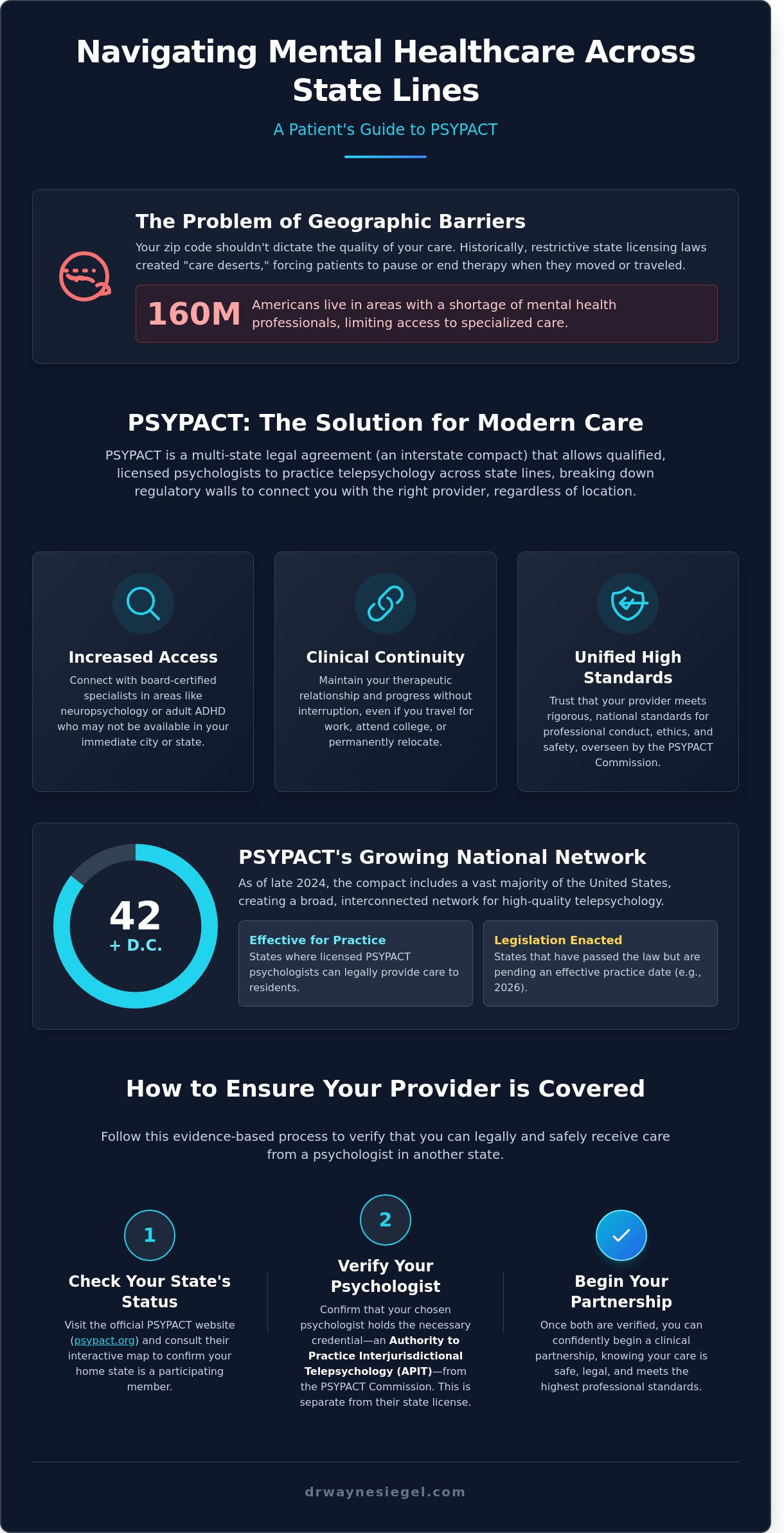
I want to show you how this legal and evidence-based framework currently connects 42 states and the District of Columbia as of late 2024. By understanding the interstate compact, you can access specialized care and maintain therapeutic continuity regardless of your physical location. This guide provides a clear roadmap for utilizing national regulations to secure precise diagnostic insights and verify that your provider is legally authorized to treat you across state lines.
Key Takeaways
- Discover how the psypact map removes geographic barriers, providing a clear visual guide to where you can access board-certified telepsychology services across state lines.
- Understand the stringent regulatory framework and the APIT credentials that ensure your interjurisdictional care meets the highest clinical and safety standards.
- Learn to navigate the 2026 legislative landscape by identifying the critical differences between states with enacted laws and those where practice is already effective.
- Follow a practical, evidence-based process to verify both your home state's participation and your psychologist’s specific authority to practice in your region.
- Gain clarity on how to expand your search for specialized mental health expertise, ensuring you receive high-quality care regardless of your physical location.
What is the PsyPact Map and Why is it Essential for Modern Mental Health?
The psypact map is a transformative tool in modern mental health care. It represents a multi-state agreement that allows licensed psychologists to practice telepsychology across state lines. I view this map as a roadmap to equity. Its core mission is to increase your access to care by reducing the regulatory hurdles that previously prevented board-certified professionals from reaching patients in different jurisdictions. Since the compact became operational in 2020, we've seen a massive shift. We are moving away from isolated, localized clinics toward a national network of specialized, evidence-based practitioners. Your zip code shouldn't dictate the quality of your psychological assessment or the depth of your therapy.
The Problem of Geographic Barriers in Psychological Care
In the United States, approximately 160 million Americans live in mental health professional shortage areas as of late 2023. These "care deserts" are particularly damaging when you need a specialist for niche areas like neuropsychological evaluations, adult ADHD, or complex trauma. Historically, if you traveled for a two-week business trip or moved across a state line, your therapy often had to pause or end entirely due to restrictive licensing laws. The psypact map was created to solve these specific clinical continuity issues. It ensures that your progress remains steady and your relationship with your provider stays intact, providing a sense of calm stability during life's transitions.
Defining PsyPact: A Solution for Interjurisdictional Practice
The Association of State and Provincial Psychology Boards (ASPPB) developed this compact to establish a high bar for clinical excellence while facilitating mobility. It operates as a formal Interstate Compact, which is a legal agreement between states to enact uniform legislation and regulatory standards. This structure allows me to offer my expertise to patients in over 40 participating states, ensuring that every psychologist in the network meets rigorous professional requirements.
This framework fundamentally changes how you might search for psychology clinics near me. Instead of being limited by physical proximity, you can now access a broader range of specialized care from the comfort of your home. My goal is to help you find clarity and a clear roadmap for your life, regardless of where you are physically located. By removing artificial geographic boundaries, we can focus on the whole person and the specific cognitive or emotional strengths that define your unique journey.
- Increased Access: Connect with specialists who may not reside in your immediate city.
- Clinical Continuity: Maintain your therapeutic relationship even if you relocate or travel.
- Unified Standards: Trust that your provider is held to a high national standard of practice.
The Regulatory Framework: How PsyPact Ensures Clinical Standards and Safety
I often meet patients who worry that online therapy might feel less secure than sitting in my physical office. The reality is that interjurisdictional practice under this framework is actually more strictly regulated than traditional state-level practice. When you examine the psypact map, you aren't just looking at a list of participating states; you're looking at a unified network of high clinical standards. This system ensures that your care remains consistent and safe, regardless of the physical distance between us.
The PSYPACT Commission maintains a rigorous oversight process that goes beyond a standard state license. It requires psychologists to demonstrate ongoing competency and adhere to a strict code of ethics. This centralized approach protects you by facilitating the exchange of disciplinary data between states. If a practitioner faces a sanction in one jurisdiction, every other state in the compact is notified immediately. This transparency is a cornerstone of patient safety that didn't exist in the same capacity before the compact's inception in 2015.
The Role of the PsyPact Commission
The commission acts as the primary governing body, ensuring that every participating psychologist meets the same high ethical and professional benchmarks. I find that this centralized oversight provides patients with much-needed clinical clarity. It removes the guesswork from seeking care across state lines. By standardizing rules across 42 states and territories as of May 2024, the commission creates a stable environment where evidence-based practices can flourish. This structure allows me to focus on your unique cognitive profile without worrying about conflicting state regulations.
E.Passport and Authority to Practice Interjurisdictional Telepsychology (APIT)
To practice through the compact, a psychologist must hold two specific credentials. First is the E.Passport, issued by the Association of State and Provincial Psychology Boards (ASPPB). This certificate confirms that I have a doctoral degree from an accredited institution and have passed the national Examination for Professional Practice in Psychology. Once the E.Passport is active, the commission grants the Authority to Practice Interjurisdictional Telepsychology (APIT).
These credentials serve as a roadmap for professional accountability. They aren't just administrative hurdles; they're your assurance that the person on the other side of the screen has been vetted at the highest level. Holding an active APIT certificate means I've committed to a high standard of digital security and clinical integrity. If you're looking for a clearer picture of your mental health, finding a provider who understands these comprehensive clinical standards is a vital first step toward your well-being. This rigorous framework ensures that the psypact map remains a reliable guide for safe, accessible, and ethical mental healthcare across the country.
Navigating the PsyPact Map: Participating States and Legislative Status in 2026
As we move through 2026, the psypact map has evolved into a nearly national standard for psychological practice. Current data shows that over 40 U.S. states and territories have passed legislation to join the compact. This widespread adoption reflects a collective recognition that mental health care shouldn't stop at state borders. I've watched this map grow from a handful of pioneering states into a robust network that provides millions of patients with access to specialized care. It represents a significant shift toward a more integrated, patient-centered healthcare system.
Enacted vs. Pending Legislation: Understanding the Map's Legend
When you visit the Official PSYPACT Website, the color-coded legend provides clarity on where your state stands. It's vital to distinguish between "Enacted" and "Effective" status. Legislation is enacted when a governor signs the bill into law; however, a state only becomes effective once the PSYPACT Commission completes the administrative onboarding process. This transition typically takes four to six months. If your state is marked as "Pending," it means a bill is currently introduced in the legislature. I encourage patients in these areas to support local advocacy groups. These grassroots efforts are the primary drivers for expanding the map into the final remaining states.
Why the Map Continues to Expand Nationally
The push for national adoption is grounded in rigorous clinical evidence. Research published in the Journal of Affective Disorders has demonstrated that telehealth delivery of Cognitive Behavioral Therapy (CBT) and Acceptance and Commitment Therapy (ACT) is just as effective as in-person sessions for treating anxiety and depression. By allowing online therapy PsyPact states to operate seamlessly, we reduce the wait times for specialists. In 2025, data indicated that cross-state practice reduced the average wait for a neuropsychological consultation by 30 percent in participating regions.
This expansion isn't just about convenience; it's about clinical stability. It ensures that if you move or travel for work, your therapeutic relationship remains intact. The psypact map serves as a roadmap for a modernized healthcare system that prioritizes the patient's journey over administrative barriers. It offers a sense of safety, knowing that high-quality, evidence-based care is accessible regardless of your zip code. This trend toward national adoption highlights a commitment to using technology to solve the mental health access crisis.
Practical Steps: How to Verify if Your Psychologist Can Practice in Your State
I believe that transparency is the foundation of a successful therapeutic relationship. Before we begin our work together, you should feel certain that your care is legally recognized and professionally regulated. Your first step is to visit the official psypact map to confirm your home state is an active participant. As of early 2024, 42 states and territories have enacted this legislation; this ensures that your psychologist is held to rigorous national standards regardless of where their physical office is located. If your state is listed as "pending," the legislation hasn't yet gone into effect, and you'll need to wait until the official start date to begin interjurisdictional sessions.
Using the PsyPact Directory for Patient Verification
Once you've confirmed your state's status, I recommend using the PsyPact "Verify" portal found on the ASPPB website. You'll need the provider's full name and their primary state of licensure to conduct a search. Look specifically for an active Authority to Practice Interjurisdictional Telepsychology (APIT) certificate. This certificate is only issued after the Association of State and Provincial Psychology Boards confirms the psychologist holds a current E.Passport. Verifying these credentials is a vital part of being an empowered patient. It confirms that I, or any other provider you choose, have met the specific requirements for ethical remote practice and maintain high professional standing.
Identifying Specialized Care Beyond State Lines
The primary benefit of the psypact map is the access it provides to niche expertise. You aren't limited to local providers who might not specialize in your unique needs. For example, if you're seeking a diagnostic evaluation, you may need to decide between an adhd adults psychiatrist or a board-certified psychologist for comprehensive testing. Psychologists often provide the deep-dive cognitive testing required for academic or workplace accommodations. I utilize evidence-based frameworks like Cognitive Behavioral Therapy (CBT) and Acceptance and Commitment Therapy (ACT) to ensure remote sessions are as effective as in-person visits. This allows you to find the right clinical fit rather than the most convenient one.
During our initial consultation, we'll discuss the logistics of interjurisdictional sessions. We'll review how we handle technical interruptions and confirm that your specific care needs, such as ADHD or executive functioning assessments, can be met safely via telehealth. I always prioritize your privacy and the security of our digital connection. My goal is to provide a roadmap that leads to genuine clarity and improved daily functioning. If you're ready to start this journey, you can schedule a consultation with me today to discuss your assessment options.
Enhancing Your Access to Evidence-Based Care through Siegel Psychology
I've dedicated my career to ensuring that high-level, board-certified clinical psychology is accessible regardless of where you live. My practice is built on the belief that rigorous science should be available to everyone, not just those within driving distance of a major medical center. By leveraging the psypact map, I'm able to extend my reach to patients in 42 states and jurisdictions as of June 2024. This credentialing allows me to provide seamless, interjurisdictional telehealth services that maintain the highest ethical and clinical standards.
Starting this journey doesn't have to be a source of stress. I focus on a person-centered approach that prioritizes your specific needs over a generic diagnostic checklist. We'll work together to identify the cognitive and emotional barriers holding you back. My commitment is to provide clarity through evidence-based methods, ensuring that every recommendation I make is backed by peer-reviewed research and clinical data.
National Reach with a Personal Partnership
I focus on bridging the gap between clinical data and compassionate care. Many people find the prospect of a neuropsychological evaluation daunting. I've designed my practice to lower that barrier. Using a secure, HIPAA-compliant platform, I can conduct thorough assessments that examine your executive functioning and cognitive profile from the comfort of your home. This digital environment doesn't sacrifice the quality of our connection; instead, it fosters a focused, one-on-one dialogue.
- Secure, end-to-end encrypted video sessions for total privacy.
- Direct access to a board-certified (ABPP) psychologist with decades of experience.
- Simplified scheduling that respects your time and geographic location.
My goal is to create a roadmap for your well-being that transcends state lines. I don't just look at symptoms. I look at how those symptoms affect your daily life. This allows us to move from a place of confusion to a place of informed action. The process is steady, deliberate, and entirely focused on your unique strengths.
Finding Clarity Beyond Geographic Boundaries
The ultimate objective of our work together is to move beyond labels. While a diagnosis can provide a name for your struggle, it's the actionable meaning we find afterward that truly matters. The psypact map facilitates a steady, deliberate pace for your healing journey. We can maintain continuity of care even if your life involves frequent travel or relocation between participating states. It's about providing a stable foundation during times of cognitive or emotional disarray.
I encourage you to take the first step toward a clearer picture of your life. You can explore your options for online therapy PsyPact states to confirm my services are available in your area. We'll work to uncover the "why" behind your challenges and build a strategy for a better quality of life. You're not just another case; you're a partner in a professional, clinical process designed for your success.
Securing Your Path to Specialized Care in 2026
The psypact map is more than just a regulatory tool; it's a bridge to specialized care that wasn't accessible just a few years ago. By 2026, this network has expanded to include 42 jurisdictions, ensuring that patients receive treatment that adheres to high clinical standards across state lines. This framework allows us to prioritize evidence-based outcomes over geographical constraints.
I've dedicated over 25 years to providing meticulous, research-driven care as a Board-Certified Clinical Psychologist. My authorization to practice in all PsyPact states means I can bring that same level of precision and empathy directly to you. We'll move beyond simple labels to find actionable meaning in your cognitive profile. It's time to gain the clarity you need to move forward with confidence. I'm here to ensure you don't have to navigate these complex questions alone.
Schedule a consultation to see if I can provide care in your PsyPact state.
I look forward to helping you find the answers you deserve.
Frequently Asked Questions
What is the PsyPact map and how does it work for patients?
The psypact map is a geographic representation of the 40 states and the District of Columbia that have enacted legislation to participate in the Psychology Interjurisdictional Compact as of late 2023. It allows patients in any participating state to access telehealth services from licensed psychologists in other member states without the provider needing multiple individual state licenses. This framework simplifies your search for specialized care by removing the traditional boundaries of state lines and local provider shortages.
Can I see a psychologist in another state if my state is on the PsyPact map?
Yes, you can receive treatment from a psychologist in another state provided both your location and the psychologist's home state are active participants on the psypact map. I can work with you across state lines because this legal framework grants me Authority to Practice Interjurisdictional Telepsychology (APIT). This ensures you maintain continuity of care and professional support even if I'm not physically located in your specific region or city.
Is online therapy through PsyPact as effective as in-person sessions?
Research indicates that online therapy is just as effective as in-person sessions for most psychological conditions. A 2020 meta-analysis published in the Journal of Psychological Disorders found that cognitive behavioral therapy delivered via telehealth produced equivalent outcomes to face-to-face treatment for anxiety and depression. I utilize these evidence-based digital platforms to provide the same level of diagnostic clarity and therapeutic support you'd receive during a traditional visit to my physical office.
How do I verify if a psychologist is authorized to practice under PsyPact?
You can verify a provider's status by checking the PSYPACT Commission website or the Association of State and Provincial Psychology Boards (ASPPB) directory. A qualified psychologist must hold an active E.Passport and an APIT certificate issued by the ASPPB to practice legally. I provide my specific credential numbers to every patient during our initial consultation so you can personally confirm my authorization to practice interjurisdictional telepsychology within your home state.
What happens if I move to a state that is not on the PsyPact map?
If you move to one of the 10 states not currently participating in the compact, I cannot legally provide telehealth services to you under this agreement. Each state board has its own regulations; some may offer temporary practice permits for 30 days, but most require a full local license. We'd need to develop a transition plan together to ensure you find a qualified local provider to continue your roadmap to cognitive health and wellness.
Does insurance cover out-of-state telehealth sessions through PsyPact?
Insurance coverage for out-of-state telehealth varies by provider and your specific plan language. While the compact facilitates legal practice, it doesn't mandate insurance reimbursement. Medicare and 43 states currently have some form of telehealth parity laws, but you should call the number on your insurance card to confirm they cover "Place of Service 02" for out-of-state providers. I'll provide the necessary documentation to help you seek reimbursement for our sessions together.
Are ADHD assessments and psychological testing allowed across state lines?
Yes, psychological testing and ADHD assessments are permitted via telehealth under PsyPact, provided the assessments are clinically appropriate for a remote format. I use validated digital tools and observation techniques that meet the same rigorous standards as in-person evaluations. Studies show that remote administration of the WAIS-IV and other cognitive batteries yields reliable data. This allows me to create your cognitive profile and offer clarity regardless of your physical location in a member state.
What is the difference between a PsyPact state and a non-participating state?
A PsyPact state has passed specific legislation that recognizes the authority of psychologists from other member states to practice via telehealth. In contrast, a non-participating state requires a psychologist to hold a full, independent license issued by that specific state's board to see any patient located there. This legislative difference currently affects roughly 20% of the U.S. population. It often creates barriers for individuals seeking specialized neuropsychological care in regions with fewer local experts.