
PsyPact States in 2026: A Comprehensive Guide to Interjurisdictional Telehealth

What if the specialist best suited to your cognitive profile is 500 miles away, yet legally accessible from your living room? As of January 2026, the legislative landscape for mental health has shifted significantly, with 42 jurisdictions now participating in the Psychology Interjurisdictional Compact. You likely feel that finding a board-certified specialist who truly understands your unique needs shouldn't be limited by your zip code. I understand the anxiety that comes with deciphering complex state licensing laws, especially when you're seeking clarity for your cognitive health. This guide explains how the expanding list of psypact states removes those barriers, ensuring you can receive evidence-based care from a provider who meets rigorous national standards.
I believe that every patient deserves a clear path to the right diagnosis, regardless of geography. This article provides the clinical authority and practical tools you need to move forward. We'll examine the most current map of participating jurisdictions, explain how to verify your psychologist’s E.Passport credentials, and provide a step-by-step roadmap to begin your out-of-state evaluation with complete legal confidence. By the end of this guide, you’ll have the insight necessary to bridge the gap between your location and the expert care you deserve.
Key Takeaways
- Learn how PSYPACT removes regulatory barriers to provide you with safe, ethical telepsychology across participating borders.
- Navigate the updated 2026 map to identify which psypact states allow you to access specialized care from the comfort of your home.
- Discover how interjurisdictional practice ensures your therapeutic journey remains uninterrupted, even if you relocate or travel between member states.
- Master the two-step verification process to confirm your psychologist holds the necessary Authority to Practice Interjurisdictional Telepsychology (APIT).
- Explore how specialized, evidence-based evaluations for ADHD and trauma are now accessible through a personal partnership that transcends traditional state lines.
What is PSYPACT and How Does It Regulate Telepsychology?
I want to help you understand how the landscape of mental health care has shifted to provide more accessible, reliable support. The Psychology Interjurisdictional Compact, known as PSYPACT, is a legal agreement between participating jurisdictions. It creates a pathway for licensed psychologists to provide services to patients located in other member regions without the need for multiple individual state licenses. This framework is essential because it bridges the gap between high-level clinical expertise and the physical location of the patient.
The core mission of this compact is to reduce regulatory barriers while maintaining the highest clinical and ethical standards. It's not just about convenience; it's about patient safety. The Association of State and Provincial Psychology Boards (ASPPB) governs the compact to ensure that every participating clinician meets rigorous requirements. I view this as a vital step toward providing a roadmap for patients who require specialized neuropsychological insights but live in areas with limited local resources. By 2026, the network of psypact states has become the standard for evidence-based practice, ensuring that your care is grounded in both science and legal protection.
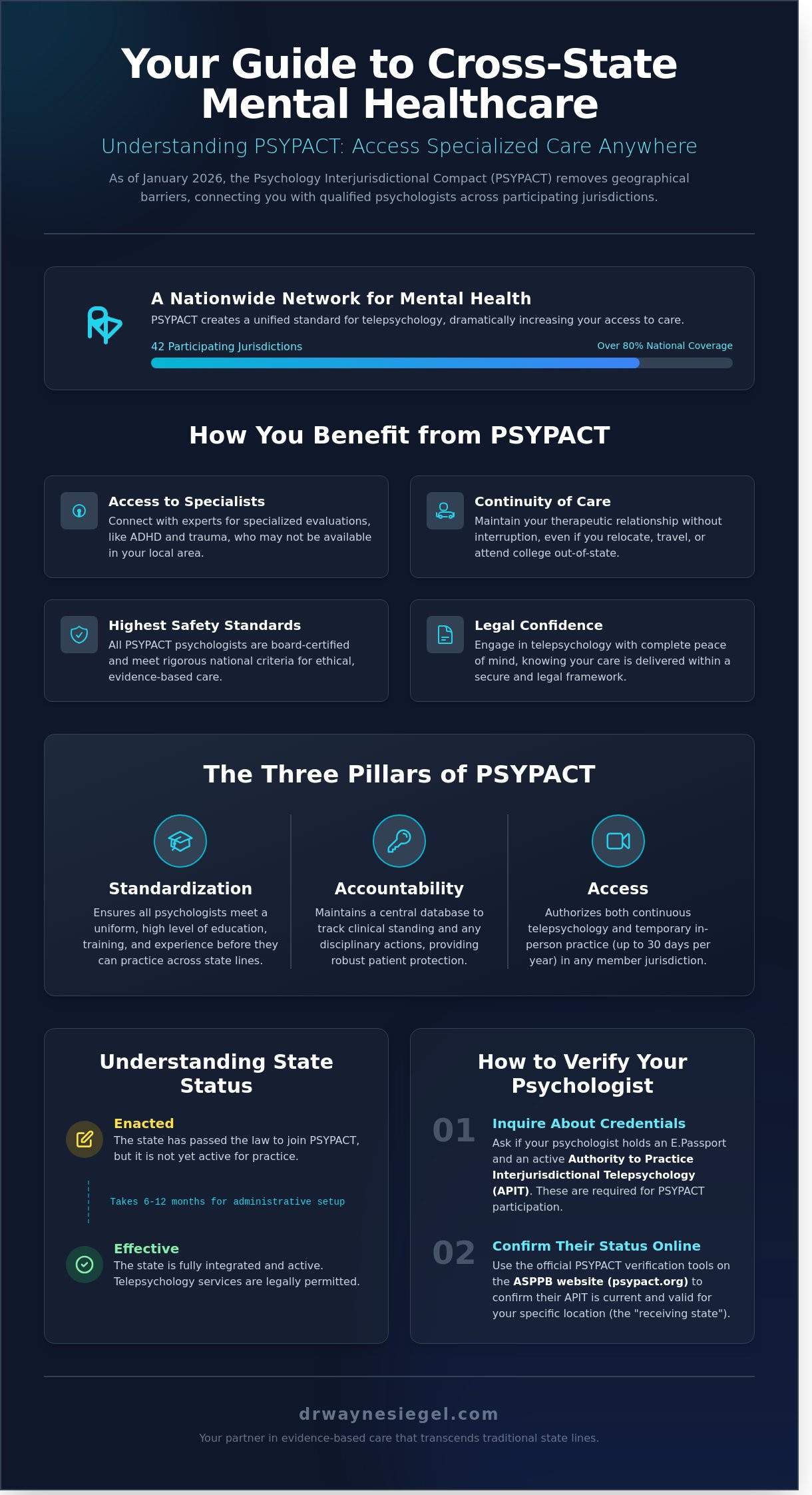
The regulation focuses on three primary pillars:
- Standardization: Ensuring all psychologists meet a uniform level of education and experience.
- Accountability: Maintaining a central database to track clinical standing and any disciplinary actions.
- Access: Allowing for both telepsychology and temporary in-person practice for up to 30 days per year.
The Evolution of Interstate Mental Health Care
The transition from state-locked licensing to this modern model represents a significant shift in medical philosophy. Before 2020, practicing across state lines was a bureaucratic hurdle that often interrupted the continuity of care. The COVID-19 pandemic acted as a massive catalyst; in early 2020, only a handful of states had fully implemented the compact. By 2026, the majority of the country has joined the psypact states list. This growth is supported by data. A 2021 study published in the Journal of Medical Internet Research confirmed that telepsychology outcomes are equivalent to in-person care for diagnostic accuracy and patient satisfaction.
Key Regulatory Bodies and Standards
The PSYPACT Commission is the governing body that protects the public by overseeing the compact's rules. They define the relationship between the "home state," where I am physically located, and the "receiving state," where you are located. To practice this way, I must hold an Authority to Practice Interjurisdictional Telepsychology (APIT). This credential, issued by the ASPPB, signifies that I've met the necessary benchmarks for ethical cross-border care. It's a system designed to give you clarity and confidence in the professional you choose, regardless of the miles between us.
The PSYPACT Map in 2026: Participating States and Legislation
The landscape of interjurisdictional practice has evolved significantly since the compact's inception. By early 2026, the number of participating psypact states has grown to include 43 jurisdictions, reflecting a national shift toward accessible, evidence-based mental health care. This expansion provides a clearer roadmap for patients seeking specialized neuropsychological care across state lines. To ensure you have the most current data, I recommend consulting The PSYPACT Map in 2026, which is maintained by the Association of State and Provincial Psychology Boards (ASPPB).
Enacted and Effective States
As of 2026, recent additions such as Vermont and South Dakota have moved from "enacted" to "effective" status. It's vital to distinguish between these two terms to avoid clinical delays. A state is "enacted" when the governor signs the legislation into law. However, it only becomes "effective" once the state board completes administrative requirements and the PSYPACT Commission grants formal entry. This process typically takes 6 to 12 months. You can use this research-driven psypact map to verify if your specific location is currently active for telepsychology services.
The 2026 launch of the PSYPACT AI Knowledge Assistant has also simplified state tracking. This tool provides real-time updates on pending legislation in states like Hawaii and Massachusetts. It helps patients understand exactly when they can expect to access care from their preferred provider. My goal is to use these tools to lower the barrier of anxiety often associated with the logistical side of healthcare.
Understanding Jurisdictional Limits
PSYPACT requires that both the psychologist and the patient are physically located in participating psypact states at the time of the session. This is a non-negotiable legal requirement designed to protect patient safety. If you travel to a non-member state for a vacation or business trip, we can't legally conduct a telepsychology session during that window. The law is precise; it focuses on the physical location of the individuals rather than their permanent residency.
Temporary practice under PSYPACT is generally limited to 30 days per calendar year in a distant state. This provides a helpful bridge for short-term needs, but it isn't a permanent solution for relocation. If you're planning a move, I can help you gain clarity on your options to ensure your care remains uninterrupted. This structured approach helps us focus on your long-term cognitive health without the stress of regulatory uncertainty.
Patient Benefits: Accessing Specialized Evidence-Based Care
I often see patients who've struggled for years because their local options were limited. The expansion of psypact states effectively ends what I call the geographic lottery. You're no longer restricted to the three or four clinicians within driving distance of your home. Instead, you can access top-tier specialists who utilize evidence-based protocols regardless of your zip code. This interjurisdictional framework ensures that if you move for a career or education between participating states, your therapeutic relationship remains intact. This continuity is vital. Clinical research consistently shows that the strength of the therapeutic alliance is one of the most significant predictors of successful outcomes. By removing state lines as a barrier, we ensure that your progress isn't reset by a change in address.
Increased competition among providers in the psypact states also drives a higher standard of clinical excellence. When patients have the freedom to choose from a national pool of experts, practitioners must stay at the forefront of psychological science to remain competitive. This marketplace dynamic benefits you directly, as it encourages the adoption of the most recent, peer-reviewed assessment techniques and treatment modalities. It moves the field away from "the way it's always been done" toward a more rigorous, data-driven approach to mental health care.
Finding the Right Clinical Fit
Finding a provider who truly understands your unique cognitive profile is essential. In a national marketplace, you can move beyond generalist clinics to find a researcher-practitioner who matches your specific diagnosis. For instance, you might seek a specialist for an adult adhd psychiatrist or a psychologist focused specifically on neuropsychological testing. I encourage you to Verify a PsyPact Psychologist’s Credentials through the official commission website to ensure they meet the rigorous standards required for interjurisdictional practice. Seeking board-certified expertise provides an extra layer of clinical safety and ensures you're receiving care grounded in the latest scientific findings rather than anecdotal evidence.
The Roadmap to Clinical Clarity
Specialized interjurisdictional care offers a much clearer picture of your cognitive and emotional health. Many of the busy professionals I work with find that specialized remote assessments provide the pragmatic answers they need without the logistical burden of travel. These evaluations aren't just about labels; they're about creating a roadmap for your future. By identifying specific executive functioning strengths and challenges, we can implement strategies that lead to a measurable improvement in daily productivity and overall quality of life. This process transforms clinical data into actionable meaning, helping you navigate your life with renewed confidence and precision. We focus on the "why" behind your challenges to find a solution that fits your specific life context.
How to Verify a PsyPact Psychologist’s Credentials
I believe that clarity is the foundation of a successful therapeutic relationship. When you seek care across state lines, you deserve the peace of mind that comes from knowing your provider is legally authorized to help you. Verifying a psychologist's credentials within the psypact states network is a straightforward process that ensures your sessions are grounded in professional accountability.
- Step 1: Confirm the Home State License. I maintain my primary license in a state that has formally adopted the compact legislation. You can verify any psychologist's primary standing through their specific state board of psychology website.
- Step 2: Verify the APIT. The Authority to Practice Interjurisdictional Telepsychology (APIT) is the specific legal grant that allows a provider to practice in other compact regions.
- Step 3: Check the E.Passport. Issued by the Association of State and Provincial Psychology Boards (ASPPB), this certificate confirms the psychologist has met the necessary educational and ethical standards.
- Step 4: Use the Official Directory. The most reliable way to confirm status is through the PSYPACT Provider Directory, which lists all psychologists currently authorized for interjurisdictional practice.
Understanding APIT and E.Passport Certificates
These credentials aren't just administrative hurdles; they're evidence of a psychologist's commitment to rigorous standards. To earn an E.Passport, I had to undergo a thorough vetting process by the ASPPB. This includes verifying a doctoral degree from an accredited institution and proof of a passing score on the Examination for Professional Practice in Psychology (EPPP). These certificates ensure that your provider follows evidence based protocols and remains under the jurisdiction of both their home state and the state where you're located.
Verifying Your Own Eligibility
Your physical location is just as important as my credentials. To receive care legally, you must be physically present in one of the participating psypact states at the exact time of our session. If you're traveling or moving, we'll need to confirm that your new location is part of the compact. During an initial online therapy PsyPact states consultation, I recommend asking, "Do you hold a current APIT number?" and "Which states are you authorized to practice in?"
Be cautious of red flags. If a provider claims they can practice anywhere in the country without mentioning the compact or specific state licenses, they may be operating outside of legal requirements. This can jeopardize your privacy and the quality of your care. My goal is to provide a roadmap that keeps you safe and supported throughout your journey.
If you're ready to gain clarity on your cognitive or emotional health, I invite you to contact my office today to discuss how we can work together through the PsyPact network.
Evidence-Based Telehealth with Siegel Psychology Services
I've dedicated my career to ensuring that your physical location doesn't limit your access to board-certified psychological care. By leveraging the legislative framework of psypact states, I provide specialized ADHD assessments and trauma-informed therapy to individuals in 42 jurisdictions. My practice is built on a foundation of clinical rigor; I believe that every patient deserves a diagnostic evaluation that is both scientifically sound and deeply empathetic. I focus on uncovering the specific data points that define your cognitive profile, moving beyond surface-level symptoms to find the root causes of your challenges.
A Personalized Partnership Across Borders
In my practice, I integrate Cognitive Behavioral Therapy (CBT) and Acceptance and Commitment Therapy (ACT) to help you navigate complex emotional landscapes. These evidence-based modalities are delivered via secure telehealth platforms, ensuring that the therapeutic alliance remains strong regardless of distance. When conducting national psychological testing, I use standardized digital tools that were validated in 2023 and 2024 research for remote administration. This process includes a comprehensive review of your executive functioning and cognitive strengths.
This research-driven lens allows me to address the whole person rather than a collection of diagnostic codes. I use a meticulous, step-by-step approach to report writing, ensuring that the final document is a tool you can use for years to come. By participating in the psypact states network, I maintain the highest ethical standards while providing you with the clarity you need to move forward with confidence.
Your Next Steps Toward Clinical Clarity
Starting your journey toward insight is a structured, intentional process. Before our first 60-minute session, you'll receive a digital intake packet to outline your clinical history and current concerns. You'll need a stable internet connection and a quiet, private environment to ensure the integrity of our conversation and any diagnostic assessments we perform. If you reside in a participating state, you can schedule an initial consultation directly through my secure patient portal.
My primary objective is to provide you with a roadmap for actionable meaning. We don't just look for labels; we look for solutions that improve your daily quality of life. Whether you're seeking an ADHD diagnosis or support for complex trauma, my goal is to transform clinical data into a clear path for growth. We'll work together to build a plan that feels manageable, respectful, and grounded in the latest psychological science.
Finding Clarity Through National Telehealth Access
The landscape of mental healthcare has shifted toward greater accessibility. By 2026, the list of psypact states has grown to include over 40 participating jurisdictions, allowing patients to bridge the gap between their location and the specialized care they require. This regulatory framework ensures that high standards of clinical practice remain consistent across state lines. I've been board-certified since 1996, and I've seen how interjurisdictional telepsychology provides a reliable roadmap for those seeking clarity. My work focuses on providing precise, evidence-based evaluations for adult ADHD and trauma. These assessments aren't just labels; they're the data-driven foundation for your future quality of life. You don't have to navigate these cognitive challenges alone. Whether you're seeking a diagnostic profile or a path toward better executive functioning, the science of neuropsychology is now more accessible than ever. Let's work together to uncover the "why" behind your struggles and build a structured plan for your success. My practice uses these rigorous standards to ensure every patient receives the same level of meticulous care regardless of their zip code.
I look forward to helping you find the answers you deserve and starting this journey together.
Frequently Asked Questions
Is my state a PsyPact state?
You can verify your location's status by checking the official PsyPact map, which currently tracks 42 enacted jurisdictions as of 2025. I recommend checking this list frequently because several states have pending legislation that could change their status within the next 6 months. If your state is listed as enacted, you have legal access to thousands of authorized psychologists across the country who can help you find the clarity you need.
Can I receive an ADHD assessment from a psychologist in another state?
You can receive a comprehensive ADHD assessment from an out-of-state provider if both you and the psychologist are located in psypact states. I use standardized digital tools to evaluate your executive functioning and cognitive profile through a secure video platform. Research from the Journal of Attention Disorders shows that remote ADHD evaluations are 95% as accurate as those conducted in person when the clinician follows established evidence-based protocols.
Does insurance cover therapy provided by a PsyPact psychologist?
Insurance coverage for interjurisdictional telepsychology depends on your specific policy, but 26 states currently have parity laws that require insurers to cover telehealth at the same rate as in-person visits. I suggest calling your member services line to confirm they recognize the Authority to Practice Interjurisdictional Telepsychology (APIT). Approximately 80% of major commercial carriers now reimburse for these services to ensure you have a consistent roadmap for your care.
What is the difference between a licensed psychologist and a PsyPact-authorized one?
A licensed psychologist is authorized to practice only within the state where they hold a specific credential, while a PsyPact-authorized psychologist has earned an additional E.Passport from the ASPPB. This authorization requires a doctoral degree from an accredited program and a passing score on the national EPPP exam. It ensures that I meet a rigorous standard for ethical practice, providing you with a sense of safety and professional reliability during our work together.
Can a PsyPact psychologist prescribe medication in my state?
PsyPact authorization doesn't grant a psychologist the right to prescribe medication in your state. The compact specifically covers telepsychology and temporary in-person practice, not prescriptive authority. If our assessment reveals that medication might be a helpful part of your journey, I'll collaborate with your local primary care physician or psychiatrist. We'll work as a team to integrate your diagnostic results into a medical treatment plan that supports your daily quality of life.
What happens if I live in a PsyPact state but my therapist does not?
Both the patient and the psychologist must be physically located in psypact states at the time of the session for the compact to apply. If your therapist isn't in a participating jurisdiction, they'd need a traditional license from your home state board to see you legally. This requirement protects you by ensuring your provider is bound by the specific consumer protection laws and ethical guidelines governed by the PsyPact Commission.
How long does a PsyPact authorization last for a psychologist?
A psychologist's Authority to Practice Interjurisdictional Telepsychology must be renewed every 12 months to remain valid. This annual process requires me to complete 3 hours of continuing education specifically focused on the technology and ethics of interjurisdictional practice. This commitment to ongoing learning ensures that the care I provide stays grounded in current research and the highest clinical standards.
Is telepsychology through PsyPact as effective as in-person therapy?
Clinical research confirms that telepsychology is as effective as in-person treatment for most cognitive and emotional challenges. A 2021 meta-analysis published in the Journal of Affective Disorders found no significant difference in clinical outcomes for patients receiving remote versus face-to-face care. My goal is to provide a steady, supportive environment that helps you gain insight into your life, whether we meet in my professional office or through a secure screen.